
The Time-Space Percentage, Explained Simply: What Home Daycare Providers Get Wrong About Their Hours
If you run a daycare out of your own home, part of your house bills — electricity, insurance, property tax, internet, repairs — relates to the business. The standard way to estimate how big that part is comes from the formula described in IRS Publication 587, and it goes by a nickname every family child care provider eventually learns: the time-space percentage.
The formula itself is short:
(hours your home is used for the business ÷ 8,760 hours in a year) × (share of your home's space used by the business)
The arithmetic is easy. What trips people up — in both directions — is what counts as an hour and what counts as space.
(Before we go further: everything here is a plain-English explanation of a published formula, for planning purposes only. It is not tax advice, and nothing beats a session with a tax professional who knows your state and your situation.)
The hours mistake #1: counting child-hours instead of home-hours
Here is the error that quietly inflates the number. If four children are in your home from noon to five, that is five hours of your home being used for business — not twenty. The house was in business use for one stretch of time, no matter how many children were in it.
The honest way to count is: first child in, last child out — one stretch per day. In one worked example we built (sixteen enrolled children, 39 logged days), the child-hours added up to 2,238 while the actual home-use hours were 377. That is a factor of almost six. A provider who logs child-hours is overstating time sixfold; a written log that counts the day as one stretch protects you.
The hours mistake #2: forgetting the hours the children are NOT there
This one runs the other way — providers understate their hours by counting only "open hours."
The formula counts hours your home is used for the business. That includes the time you spend cleaning up after the children leave, cooking their meals in advance, preparing activities, doing enrollment paperwork, invoicing parents, and taking the training your license requires — as long as it happens in your home. In the same worked example, that before-and-after work added 830 hours a year on top of 2,625 hours of open time — close to a quarter of the total business hours, and the part most often left out entirely.
Providers who skip this are giving up a real, defensible share of the calculation. The catch: you need a record of it, which is exactly why a log beats a guess.
The space side: exclusive rooms are different
The space share is not just "how many rooms do the kids use." The formula distinguishes:
- Rooms used regularly for the daycare and also by your family — these count at your time percentage.
- Rooms used exclusively for the daycare (a dedicated playroom, a storage room that holds only daycare supplies) — these are in business use all the time, and there is a recognized way to count them more fully.
Whether you have any truly exclusive-use space, and how to apply the exclusive-use calculation, is precisely the kind of question to bring to your tax professional — but you cannot bring it to them if you never measured your rooms. Measure once, write it down.
What this looks like with real numbers
Using our worked example throughout (all editable placeholder data — your numbers will differ):
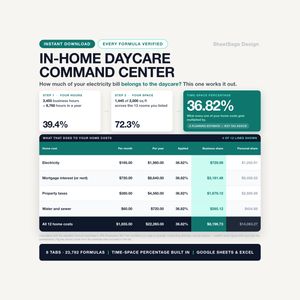
- 3,455 business hours ÷ 8,760 = 39.4% time
- 1,445 of 2,000 sq ft used for the daycare = 72.3% space
- Classic calculation: 28.5%
- Counting the daycare-only rooms in full: 36.82%
Applied to $22,260 a year of home costs, that difference in method is worth thousands — which is exactly why the worked-out version belongs on paper, in front of a professional, rather than in your head at filing season.
The record-keeping habit that makes all of it defensible
Every part of this stands or falls on records:
- A daily attendance log — time in, time out, per child. It produces both your billing and your first-in-to-last-out hours automatically.
- A standing weekly tally of before-and-after hours — cleaning, cooking, prep, admin, training.
- A room list with measurements — which rooms the daycare uses, which are exclusive.
- A home-cost list — the twelve or so annual bills the percentage will be applied to.
Keep those four things current and the time-space percentage stops being a guess you make once a year and becomes a number that recalculates itself — one you can hand to your tax professional with a straight face.
Doing the arithmetic without doing it twice a year
The formula itself is one line. What takes the time is counting a day as one stretch instead of child-hours, tallying a quarter's worth of before-and-after hours, measuring which rooms are exclusive, and then applying whichever percentage you land on to twelve separate home bills — by hand, from scratch, whenever filing season reminds you it exists.
Our In-Home Daycare Command Center runs that whole chain for you. It reads your attendance log and counts each day first-child-in to last-child-out, so it catches the child-hours mistake automatically — in the example file that is 2,238.87 child-hours against 377.32 actual hours of home use, a difference of almost six times. It separates rooms used only for the daycare from rooms shared with your family and shows both readings side by side — 28.5% counted the classic way, 36.82% with the daycare-only rooms counted in full, in the example file. Then it applies whichever percentage you choose to twelve lines of home costs — electricity, insurance, property tax, and the rest — and splits every one of them into a business share and a personal share on its own: $22,260 a year of costs splits into $8,196.73 business and $14,063.27 personal in the example file.
Google Sheets and Microsoft Excel, one file, instant download, no subscription.
It calculates the Time-Space Percentage using the standard formula described in IRS Publication 587 — a planning estimate, not tax advice; confirm with your tax professional. It does not know your state or your licensing status, and following your licensor's ratio and safety rules is separate from anything this spreadsheet does.
The percentage does not change how big your house is. It changes what you can defend when you sit down with the person who does your taxes.
 Every other daycare spreadsheet in these results is a logbook. This one is a calculator.…
See the In-Home Daycare Business Command Center →