
Etsy Fees Calculator: How to Price Your Products So You Actually Make Money
Most Etsy pricing advice tells you to pick a number and see what happens. That is not pricing — that is a guess with a price tag on it.
Real pricing runs in the other direction. You start from the profit you need, add back every fee and every cost, and arrive at the price. It is a single formula, it takes about four seconds once you have it set up, and it is the difference between a shop that is busy and a shop that pays you.
This guide covers both directions: the forward calculation (what does this price actually net me?) and the reverse calculation (what price gets me the profit I want?).
First, the fees you are pricing against
You cannot calculate around fees you have not counted. As of August 2026, a sale on Etsy can carry six of them:
| Fee | Rate | When it applies |
|---|---|---|
| Listing fee | $0.20 | On publish, and again on every sale (auto-renew) |
| Transaction fee | 6.5% | On the full order total, shipping included |
| Payment processing | Varies by country — US 3.0% + $0.25 | Every order |
| Offsite Ads | 15% under $10K trailing sales, 12% above | Only on ad-attributed orders |
| Currency conversion | 2.5% | When listing currency ≠ bank currency |
| Regulatory operating fee | Varies by country, often 0% | Certain countries only |
Payment processing changes materially depending on where your shop is based:
| Shop country | Payment processing |
|---|---|
| United States | 3.0% + $0.25 |
| United Kingdom | 4.0% + £0.20 |
| Canada | 3.0% + CA$0.25 |
| Australia | 3.0% + AU$0.25 |
| Germany / France / EU | 4.0% + €0.30 |
| Israel | 5.0% + ₪2.00 |
Etsy updates these periodically. Confirm your own rate in your Payment account rather than assuming.
For the worked examples below I will use a US shop selling a digital product with Offsite Ads switched off — the simplest case. Swap in your own rates and the method is identical.
The forward calculation: what does this price net me?
Take a listing at $19.99:
| Line | Amount |
|---|---|
| Sale price | $19.99 |
| Listing fee | −$0.20 |
| Transaction fee (6.5%) | −$1.30 |
| Payment processing (3.0% + $0.25) | −$0.85 |
| Total fees | −$2.35 |
| Net | $17.64 |
Useful, but limited. It tells you what happened to a price you already chose. It does not help you choose one.
The reverse calculation: what price gets me the profit I want?
Here is the whole thing. Separate your fees into two buckets — the percentage ones and the fixed-dollar ones — and then:
Price = (Target profit + Costs + Fixed fees) ÷ (1 − Percentage fees)
For a US digital seller with Offsite Ads off:
- Percentage fees = 6.5% + 3.0% = 9.5%, so
1 − 0.095 = 0.905 - Fixed fees = $0.20 + $0.25 = $0.45
- Costs = $0 for a digital download
Want to clear $15 on every sale?
Price = (15.00 + 0 + 0.45) ÷ 0.905 = 17.07
List at $17.07 and you net $15.00. Not $15 in revenue with fees to worry about later — $15 in your pocket.
The most common mistake here is dividing when you should not be, or worse, just adding the fee percentage to your target. Adding 9.5% to $15 gives you $16.43, which nets $14.42 — you are $0.58 short on every single sale. That gap compounds silently across hundreds of orders.
The reverse pricing table
| You want to keep | List at |
|---|---|
| $5.00 | $6.03 |
| $10.00 | $11.55 |
| $15.00 | $17.07 |
| $20.00 | $22.60 |
| $25.00 | $28.13 |
US shop, digital product, Offsite Ads off. Rounded up to the cent.
Adding your costs (physical products)
If you make something, your materials and packaging go into the same formula — before the division, alongside your target profit.
A candle: wax, wick and vessel come to $6.40, packaging is $1.10, and you want $12.00 of profit per unit.
Price = (12.00 + 7.50 + 0.45) ÷ 0.905 = 22.05
List at $22.05. Check it: $22.05 × 0.905 = $19.96, minus the $0.45 fixed = $19.51, minus $7.50 of materials = $12.01. Correct.
Shipping deserves its own warning. Etsy's 6.5% transaction fee applies to the order total including the shipping you charged. If you charge $6.00 shipping and your postage costs $6.00, you are down $0.39 on the shipping alone before anything else. Either build that into the item price or accept that "free shipping" and "shipping at cost" are not the same thing.
Pricing when Offsite Ads are on
This is where a lot of otherwise-careful pricing falls over. Offsite Ads at 15% is a big number, and it lands on the whole order total.
If you priced at $17.07 to net $15.00, an ad-attributed order at that price nets:
17.07 × (1 − 0.095 − 0.15) − 0.45 = $12.44
You lost $2.56 of profit on that order. Not catastrophic on one — meaningful across a season.
You have two honest options.
Option A: price for the worst case. Put the full 15% into your percentage bucket:
Price = 15.45 ÷ (1 − 0.245) = 20.47
Every order clears $15, ad-attributed or not. The cost is that you are the most expensive listing in your category for buyers who found you organically.
Option B: price for the blend. If roughly 20% of your orders come through Offsite Ads, the effective drag is 20% × 15% = 3%:
Price = 15.45 ÷ (1 − 0.125) = 17.66
Individual orders vary, but your average lands where you wanted it. This is usually the better answer — provided you actually measure your attribution rate instead of estimating it. Mark ad-attributed orders in your sales log and recalculate the blend every quarter.
Four pricing rules the math keeps producing
1. Set a price floor around $10. Fixed fees do not scale. At $4.99 Etsy's cut is 18.5%; at $19.99 it is 11.75%. Cheap products are not just less profitable per sale — they hand over a larger share of what you do earn.
2. Price on outcome, not on effort. "Budget spreadsheet" competes with tens of thousands of listings on price alone. "Variable-income budget tracker for freelancers" competes on fit, and fit sustains a higher price. The longer, more specific description of who it is for is what lets you use the top half of the reverse pricing table instead of the bottom.
3. Use the psychological price points, but calculate first. Prices ending in .99 do outperform round numbers, and $14.99 and $19.99 are strong points on Etsy. Run the reverse calculation, then round up to the nearest .99 — never down. If the math says $17.07, list at $17.99, not $16.99.
4. Recalculate when anything changes. New country, new payout currency, Offsite Ads crossing the $10,000 threshold from 15% to 12%, an Etsy fee update — each one moves every price in your shop. If recalculating means an evening with a calculator, you will not do it, and your prices will slowly drift out of date.
Do this in a spreadsheet, once
Every calculation in this article is the same formula with different inputs. That is precisely what spreadsheets exist for — and precisely what most sellers are doing by hand, badly, on the back of an envelope.
If you just want the numbers above in front of you without opening a full dashboard, our Etsy Fees Cheat Sheet is the fast version: a one-page printable reference with all six fees explained in plain English, payment processing rates by country, a $19.99 sale broken down line by line, a "what you keep" table for every price from $4.99 to $49.99, and the reverse-pricing formula above already worked out — plus a small Mini Fee Calculator spreadsheet that runs both directions of the math the moment you type a price. $6.99, two files, instant download.
If you would rather track every sale, every month and every listing automatically instead of calculating one price at a time, the bigger Etsy Seller Fee Calculator & Profit Dashboard does that — the same fee math above, plus a sales log, a reverse calculator, a listings comparison and a monthly profit dashboard.
Pricing is not a personality trait or a confidence problem. It is a division. Set it up once and it stops being a decision you dread and starts being a number you read.
This is an independent tool and guide, not affiliated with or endorsed by Etsy, Inc. Fee rates are current as of August 2026 and are fully editable in the spreadsheet as Etsy updates them. Nothing here is tax or financial advice — for tax questions, talk to an accountant in your jurisdiction.
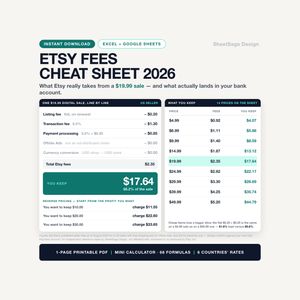 Etsy takes six different fees out of a sale, and most of them are invisible until the payout lands. This is the one-page reference card that puts all of them in front of you, with the exact …
See the Etsy Fees Cheat Sheet 2026 →